


Friday June 4, 2010
Another later start to the day as we don’t have to be at Gilala school until 10:00. Peter and I gather up empty 1.5L water bottles to take to the CPAR office to fill to use for drip irrigation for the trees we are to plant. Water from the Karatu pipeline is a muddy brownish colour. People must boil it before they can drink it.
Into the jeeps and on the way in the heavy mist – very close to rain. Gilala Primary School is located in the picturesque highland village of Kili Matembo (Elephant Hill). There is mud everywhere! We get out of the jeeps and take about 10 steps before we are carrying an extra 10 pounds on each shoe..JPG) We are welcomed by the head teacher and the assistant head teacher, who acts as the translator and MC and seems to be in charge of the agenda. First, into the office to sign the guest book. Next, ceremonial welcoming speeches. The Tanzania students sang us a Tanzania song (not the national anthem but a very pretty song about Tanzanian pride) and the Canadian contingent introduced each individual. Again, I find it hard to explain that I teach Computer Science to children that don’t have electricity. I just say I’m a teacher.
We are welcomed by the head teacher and the assistant head teacher, who acts as the translator and MC and seems to be in charge of the agenda. First, into the office to sign the guest book. Next, ceremonial welcoming speeches. The Tanzania students sang us a Tanzania song (not the national anthem but a very pretty song about Tanzanian pride) and the Canadian contingent introduced each individual. Again, I find it hard to explain that I teach Computer Science to children that don’t have electricity. I just say I’m a teacher. .JPG) We toured the tanks, girls latrines, and drinking/handwashing stations. They demonstrated how everything worked and explained the job of the school water committee, stressing that it consisted of 2 boys and 2 girls so there would be gender equality. The teacher looked at the CPAR reps as he made this last point, but I’m not sure everyone really bought in to the gender equality concept – there’s a ways to go.
We toured the tanks, girls latrines, and drinking/handwashing stations. They demonstrated how everything worked and explained the job of the school water committee, stressing that it consisted of 2 boys and 2 girls so there would be gender equality. The teacher looked at the CPAR reps as he made this last point, but I’m not sure everyone really bought in to the gender equality concept – there’s a ways to go. .JPG)
.JPG) We then planted trees with the students. It was a lot of fun – we were already completely covered with mud. Those children, obviously farmers, were no strangers to working a hand hoe!
We then planted trees with the students. It was a lot of fun – we were already completely covered with mud. Those children, obviously farmers, were no strangers to working a hand hoe! .JPG) We planted about 50 trees in the fertile volcanic soil and settled in the pop bottles for drip irrigation.
We planted about 50 trees in the fertile volcanic soil and settled in the pop bottles for drip irrigation. .JPG) Cleaned up for lunch – we ate in a separate classroom since we had box lunches and the African students were eating a maize and beans mixture. Their food was actually very good – Janice traded parts of her lunch for a sample of their lunch and we all had a taste.
Cleaned up for lunch – we ate in a separate classroom since we had box lunches and the African students were eating a maize and beans mixture. Their food was actually very good – Janice traded parts of her lunch for a sample of their lunch and we all had a taste..JPG) Following lunch was more ceremony – singing and dancing. The village chairperson made a speech about how pleased they were with the collaboration and hoping it would continue.
Following lunch was more ceremony – singing and dancing. The village chairperson made a speech about how pleased they were with the collaboration and hoping it would continue. .JPG) We were presented with gifts of Masai shukas (blankets). Janice was drawn into a dance and wrapped in a kanga – she was so excited she nearly ripped a hamstring jumping around. Peter finally danced! Susan was presented with 2 shukas (one's for you, Daria!). The parents were honoured with 4 and the students presented with 4, which we will divide up randomly.
We were presented with gifts of Masai shukas (blankets). Janice was drawn into a dance and wrapped in a kanga – she was so excited she nearly ripped a hamstring jumping around. Peter finally danced! Susan was presented with 2 shukas (one's for you, Daria!). The parents were honoured with 4 and the students presented with 4, which we will divide up randomly.
.JPG) We then brought out the bag of sports equipment for the school and a soccer game ensued. 3 - 2, thanks to Devin for both goals. Everyone was playing some kind of game or making some sort of connection. Even the tour bus drivers were playing soccer with the kids.
We then brought out the bag of sports equipment for the school and a soccer game ensued. 3 - 2, thanks to Devin for both goals. Everyone was playing some kind of game or making some sort of connection. Even the tour bus drivers were playing soccer with the kids..JPG)
.JPG)
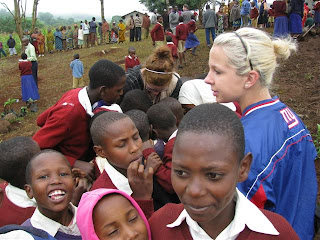
The people in this village seemed to be a little more worldly, perhaps because they are a bit closer to Karatu town. They had much better English, and were very curious about life in Canada. I brought out some pictures of my family and some winter pictures and was immediately mobbed by people young and old who were absolutely fascinated with the photographs. As usual, everyone is very curious about Mary – they do not understand the concept of a black Canadian and assume she is the only one. Some other ideas are also difficult to explain. What is the importance of forests in Canada? Do we use them for firewood? How do our houses withstand the cold (many people here live in houses with walls of mud and a roof of thatched grass)? Why am I not a grandmother at my age? (tried not to let that last one get to me)..JPG) Finally left at about 3:30 and drove back home. Many students went into town but I sat out with a book in my hands – which immediately attracted people to sit around and talk. Everyone got spiffed up a bit and we went to Happy Days for a change of pace for dinner. Some students wanted to go home immediately after dinner (having a bit of a hard time adjusting to new experiences) but we told them to stick it out for a bit. Started playing the kids’ music (shudder) and they all started dancing and even had some of our drivers up and dancing with them, so everyone had a good time.
Finally left at about 3:30 and drove back home. Many students went into town but I sat out with a book in my hands – which immediately attracted people to sit around and talk. Everyone got spiffed up a bit and we went to Happy Days for a change of pace for dinner. Some students wanted to go home immediately after dinner (having a bit of a hard time adjusting to new experiences) but we told them to stick it out for a bit. Started playing the kids’ music (shudder) and they all started dancing and even had some of our drivers up and dancing with them, so everyone had a good time. .JPG) Went home at about 10:00 and had a minor mishap when one student had her hand caught in a jeep door. Peter cleaned and carefully bandaged it while someone held a flashlight. After he was finished, the student with the injured hand pointed out that he had missed the actual wound, so we had to take it off and do it again.
Went home at about 10:00 and had a minor mishap when one student had her hand caught in a jeep door. Peter cleaned and carefully bandaged it while someone held a flashlight. After he was finished, the student with the injured hand pointed out that he had missed the actual wound, so we had to take it off and do it again.
Another later start to the day as we don’t have to be at Gilala school until 10:00. Peter and I gather up empty 1.5L water bottles to take to the CPAR office to fill to use for drip irrigation for the trees we are to plant. Water from the Karatu pipeline is a muddy brownish colour. People must boil it before they can drink it.
Into the jeeps and on the way in the heavy mist – very close to rain. Gilala Primary School is located in the picturesque highland village of Kili Matembo (Elephant Hill). There is mud everywhere! We get out of the jeeps and take about 10 steps before we are carrying an extra 10 pounds on each shoe.
We are welcomed by the head teacher and the assistant head teacher, who acts as the translator and MC and seems to be in charge of the agenda. First, into the office to sign the guest book. Next, ceremonial welcoming speeches. The Tanzania students sang us a Tanzania song (not the national anthem but a very pretty song about Tanzanian pride) and the Canadian contingent introduced each individual. Again, I find it hard to explain that I teach Computer Science to children that don’t have electricity. I just say I’m a teacher. We toured the tanks, girls latrines, and drinking/handwashing stations. They demonstrated how everything worked and explained the job of the school water committee, stressing that it consisted of 2 boys and 2 girls so there would be gender equality. The teacher looked at the CPAR reps as he made this last point, but I’m not sure everyone really bought in to the gender equality concept – there’s a ways to go. We then planted trees with the students. It was a lot of fun – we were already completely covered with mud. Those children, obviously farmers, were no strangers to working a hand hoe! We planted about 50 trees in the fertile volcanic soil and settled in the pop bottles for drip irrigation. Cleaned up for lunch – we ate in a separate classroom since we had box lunches and the African students were eating a maize and beans mixture. Their food was actually very good – Janice traded parts of her lunch for a sample of their lunch and we all had a taste. Following lunch was more ceremony – singing and dancing. The village chairperson made a speech about how pleased they were with the collaboration and hoping it would continue. We were presented with gifts of Masai shukas (blankets). Janice was drawn into a dance and wrapped in a kanga – she was so excited she nearly ripped a hamstring jumping around. Peter finally danced! Susan was presented with 2 shukas (one's for you, Daria!). The parents were honoured with 4 and the students presented with 4, which we will divide up randomly.We then brought out the bag of sports equipment for the school and a soccer game ensued. 3 - 2, thanks to Devin for both goals. Everyone was playing some kind of game or making some sort of connection. Even the tour bus drivers were playing soccer with the kids.The people in this village seemed to be a little more worldly, perhaps because they are a bit closer to Karatu town. They had much better English, and were very curious about life in Canada. I brought out some pictures of my family and some winter pictures and was immediately mobbed by people young and old who were absolutely fascinated with the photographs. As usual, everyone is very curious about Mary – they do not understand the concept of a black Canadian and assume she is the only one. Some other ideas are also difficult to explain. What is the importance of forests in Canada? Do we use them for firewood? How do our houses withstand the cold (many people here live in houses with walls of mud and a roof of thatched grass)? Why am I not a grandmother at my age? (tried not to let that last one get to me).
Finally left at about 3:30 and drove back home. Many students went into town but I sat out with a book in my hands – which immediately attracted people to sit around and talk. Everyone got spiffed up a bit and we went to Happy Days for a change of pace for dinner. Some students wanted to go home immediately after dinner (having a bit of a hard time adjusting to new experiences) but we told them to stick it out for a bit. Started playing the kids’ music (shudder) and they all started dancing and even had some of our drivers up and dancing with them, so everyone had a good time. Went home at about 10:00 and had a minor mishap when one student had her hand caught in a jeep door. Peter cleaned and carefully bandaged it while someone held a flashlight. After he was finished, the student with the injured hand pointed out that he had missed the actual wound, so we had to take it off and do it again.
.JPG) CPAR provided one female dairy goat which the farmer breeds and sells the extra goats. He now has a herd of about 5 or 6 goats, which he can sell for about 100,000 shillings each. The extra money he has is now used for visits to the doctor for his son. The milk he uses for his family. His farm was spotless and very well-tended.
CPAR provided one female dairy goat which the farmer breeds and sells the extra goats. He now has a herd of about 5 or 6 goats, which he can sell for about 100,000 shillings each. The extra money he has is now used for visits to the doctor for his son. The milk he uses for his family. His farm was spotless and very well-tended. .JPG) The precious dairy goats were in a separate barn to keep them free from diseases carried by ordinary goats or cows, which were kept in a separate enclosure formed by a ring of trees. Mikali travels 2 km twice daily to collect water for his family, and collects water for his animals from a nearby (about 1.5 km away) slough.
The precious dairy goats were in a separate barn to keep them free from diseases carried by ordinary goats or cows, which were kept in a separate enclosure formed by a ring of trees. Mikali travels 2 km twice daily to collect water for his family, and collects water for his animals from a nearby (about 1.5 km away) slough..JPG) They experiment as a group with the combined acreage, planting ground cover crops like beans between rows of maize to help the soil retain moisture and return nutrients to the soil. The teachers are the CPAR staff workers – Nderingo, Dayo, and Japhet, who all hold degrees in agricultural studies from university. Through this experimentation, the farmers have been able to increase their yield by as much as 8 times that of traditional methods. Harvest from the shamba darasa (Farmers' Field School) is sold and the money reinvested in the group, which is quite formalized with a chair, vice-chair, secretary, and treasurer. After the discussion of the project, the farmers danced a traditional Iraqu tribal dance to welcome us and express their pleasure at our visit. They handed us each bottles of mineral water, a most precious gift indeed, as a sign of their respect.
They experiment as a group with the combined acreage, planting ground cover crops like beans between rows of maize to help the soil retain moisture and return nutrients to the soil. The teachers are the CPAR staff workers – Nderingo, Dayo, and Japhet, who all hold degrees in agricultural studies from university. Through this experimentation, the farmers have been able to increase their yield by as much as 8 times that of traditional methods. Harvest from the shamba darasa (Farmers' Field School) is sold and the money reinvested in the group, which is quite formalized with a chair, vice-chair, secretary, and treasurer. After the discussion of the project, the farmers danced a traditional Iraqu tribal dance to welcome us and express their pleasure at our visit. They handed us each bottles of mineral water, a most precious gift indeed, as a sign of their respect..JPG)
.JPG) UMATU is a combination of words meaning love and hope. It began in 2005 by 2 women and has grown astronomically since then. There is a great stigma against HIV positive people in Tanzania. UMATU are women who have accepted HIV, are on ARV’s and have broken the silence. They talk to people, showing them that they are strong and healthy and provide counseling and encourage people to get tested for HIV. CPAR has helped build capacity in this organization so they can stand alone. They have a number of income generation projects under way, with many plans for expansion.
UMATU is a combination of words meaning love and hope. It began in 2005 by 2 women and has grown astronomically since then. There is a great stigma against HIV positive people in Tanzania. UMATU are women who have accepted HIV, are on ARV’s and have broken the silence. They talk to people, showing them that they are strong and healthy and provide counseling and encourage people to get tested for HIV. CPAR has helped build capacity in this organization so they can stand alone. They have a number of income generation projects under way, with many plans for expansion. .JPG)
.JPG) We toured the building and the girls were delighted to find they could purchase bags made from kangas (brightly printed lengths of cloth with Swahili sayings printed on them). Any chance to shop makes it a great day! Many more ordered bags (they really are great!) for the next day.
We toured the building and the girls were delighted to find they could purchase bags made from kangas (brightly printed lengths of cloth with Swahili sayings printed on them). Any chance to shop makes it a great day! Many more ordered bags (they really are great!) for the next day..jpg)
.JPG) Very tough work! We kept passing the hoe around so no one got too tired, but the African kids were obviously far superior when it came to this basic farming skill. The hole I was trying to dig was basically taken over by one of the QL teachers - he was trying to be polite, but I could tell he was thinking "we haven't got all day!" After the whole was the prescribed size (thank goodness the trees were actually just seedlings), we added a bit of manure for fertilizer (Pete got the nice fresh stuff, much tothe amusement of the QL children he was working with), plunked the tree in, covered it a bit and added a large plastic water bottle with a hole punched in it so it would drip-irrigate the tree. We planted guava, fig, orange, papaya, and croton trees - all about 8 inches tall. They will be fruit-bearing in about 2 - 3 years!
Very tough work! We kept passing the hoe around so no one got too tired, but the African kids were obviously far superior when it came to this basic farming skill. The hole I was trying to dig was basically taken over by one of the QL teachers - he was trying to be polite, but I could tell he was thinking "we haven't got all day!" After the whole was the prescribed size (thank goodness the trees were actually just seedlings), we added a bit of manure for fertilizer (Pete got the nice fresh stuff, much tothe amusement of the QL children he was working with), plunked the tree in, covered it a bit and added a large plastic water bottle with a hole punched in it so it would drip-irrigate the tree. We planted guava, fig, orange, papaya, and croton trees - all about 8 inches tall. They will be fruit-bearing in about 2 - 3 years! .JPG) After the trees were planted, the fun began! Some of the sports equipment from Canada was brought out and we demonstrated frisbees and badminton, When the skipping ropes came out - the QL kids went nuts - they are master-skippers! Usually in pairs, even on the small ropes. There were kids all over the place.
After the trees were planted, the fun began! Some of the sports equipment from Canada was brought out and we demonstrated frisbees and badminton, When the skipping ropes came out - the QL kids went nuts - they are master-skippers! Usually in pairs, even on the small ropes. There were kids all over the place. .JPG) Devin played gorrilla and had the small children chasing him screaming all over the school yard and up a tree. In what surely could be construed as a criminal act, our kids taught the Tanzanian children the Bird Dance (bad enough we have it in Manitoba, no need to infect the rest of the world). Our girls learned one of the songs and dances the African children performed for us - very cute and involved much tiny booty-shaking.
Devin played gorrilla and had the small children chasing him screaming all over the school yard and up a tree. In what surely could be construed as a criminal act, our kids taught the Tanzanian children the Bird Dance (bad enough we have it in Manitoba, no need to infect the rest of the world). Our girls learned one of the songs and dances the African children performed for us - very cute and involved much tiny booty-shaking..JPG) After lunch at the hostel, we walked down the road to visit UMATU.
After lunch at the hostel, we walked down the road to visit UMATU.
.JPG) Woke up to a very cool morning and another great Sopa lodge shower and a breakfast buffet that goes on for about a mile. Get on the road by about 8ish after Peter fails to negotiate his way out of paying for the milk consumed the night before (it was free at the first lodge and they didn't even charge all of the tables, so it should have been an easy battle). Take a very steep and scenic drive down into the crater. Spy a lion in the grass almost immediately! Other wildlife is soon evident, and we come across a hyena, well-fed, resting beside the road that didn't even blink when we stopped to say "jambo."
Woke up to a very cool morning and another great Sopa lodge shower and a breakfast buffet that goes on for about a mile. Get on the road by about 8ish after Peter fails to negotiate his way out of paying for the milk consumed the night before (it was free at the first lodge and they didn't even charge all of the tables, so it should have been an easy battle). Take a very steep and scenic drive down into the crater. Spy a lion in the grass almost immediately! Other wildlife is soon evident, and we come across a hyena, well-fed, resting beside the road that didn't even blink when we stopped to say "jambo.".JPG) The jeep drivers were very knowledgeable and gave us quite an education about the origins of the crater, its inhabitants, and the surrounding area. The crater covers about 17 sq km and has vastly different landscapes - dry flatland grasses (warthogs, hyenas, gazelles, rhino (wa-a-y far away), ostriches, wildebeast, zebra),
The jeep drivers were very knowledgeable and gave us quite an education about the origins of the crater, its inhabitants, and the surrounding area. The crater covers about 17 sq km and has vastly different landscapes - dry flatland grasses (warthogs, hyenas, gazelles, rhino (wa-a-y far away), ostriches, wildebeast, zebra), .JPG)
.JPG) lush rainforest (elephants, baboons), swampy watering holes (hippos, cranes, lions - LOTS of lions, it was gr-r-reat), and a lake.
lush rainforest (elephants, baboons), swampy watering holes (hippos, cranes, lions - LOTS of lions, it was gr-r-reat), and a lake. .JPG) The lake is supposedly covered with flamingos during the dry season, and they get really pink when they eat the algae. It is apparently quite an amazing site. This, however, is not the dry season and the dumb birds have all migrated to another lake in either Kenya or another part of Tanzania. We saw a few slightly pink flamingos (I guess the lazy ones that didin't migrate) from quite a distance.
The lake is supposedly covered with flamingos during the dry season, and they get really pink when they eat the algae. It is apparently quite an amazing site. This, however, is not the dry season and the dumb birds have all migrated to another lake in either Kenya or another part of Tanzania. We saw a few slightly pink flamingos (I guess the lazy ones that didin't migrate) from quite a distance..JPG)
.JPG) Saw majestically graceful giraffes, some monkeys with either blue bums or blue other parts of their nether regions (apparently this encited much discussion in Jan's jeep as she had all the boys), and a crocodile back (maybe a log - we just took our guide's word for it). Driving through the Serengeti is very dusty - especially with the top up and standing up to catch everything. We all have a litany of bruises (badges of homour) from slamming into the doors, roof, etc of the jeeps as we bumped along. Came across absolutely gazillions of zebra. Zebra as far as the eye could see. And this is not apparently the high season.
Saw majestically graceful giraffes, some monkeys with either blue bums or blue other parts of their nether regions (apparently this encited much discussion in Jan's jeep as she had all the boys), and a crocodile back (maybe a log - we just took our guide's word for it). Driving through the Serengeti is very dusty - especially with the top up and standing up to catch everything. We all have a litany of bruises (badges of homour) from slamming into the doors, roof, etc of the jeeps as we bumped along. Came across absolutely gazillions of zebra. Zebra as far as the eye could see. And this is not apparently the high season. .JPG) We laughed at how excited we were a few days ago when we glimpsed our first few zebra - who knew we soon be plowing through them on the road?
We laughed at how excited we were a few days ago when we glimpsed our first few zebra - who knew we soon be plowing through them on the road?.JPG) Saw hippos (barely), lions with cubs, and lions with a fresh kill (fairly gross - but interesting). Stopped for lunch at same place as yesterday and had box lunches (this is a big thing here - it comes in an actual box!) from the Sopa lodge.
Saw hippos (barely), lions with cubs, and lions with a fresh kill (fairly gross - but interesting). Stopped for lunch at same place as yesterday and had box lunches (this is a big thing here - it comes in an actual box!) from the Sopa lodge..JPG)
.JPG) We were then separated into small groups and taken inside separate itty-bitty mud huts to see how they lived - very primitive indeed. Then shown the array of ubiquitous trinkets and jewellery and convinced to part with yet more of our shillings. The women all work hard making the jewellery and the beadwork on the crafts is beutiful. We were taken to a kindergarten class in a small hut that promptly sang us a song in Masai and showed us how well the tiny tots could count in English - a necessary skill for fleecing tourists.
We were then separated into small groups and taken inside separate itty-bitty mud huts to see how they lived - very primitive indeed. Then shown the array of ubiquitous trinkets and jewellery and convinced to part with yet more of our shillings. The women all work hard making the jewellery and the beadwork on the crafts is beutiful. We were taken to a kindergarten class in a small hut that promptly sang us a song in Masai and showed us how well the tiny tots could count in English - a necessary skill for fleecing tourists. .JPG)
.JPG) This lodge is even nicer than the one at Serengeti! Temperature is very cold (maybe less than 10 degrees) - Peter refuses to wear long pants in Africa, but the rest of us bundle up. Have a marvelous dinner, complete with a birthday celebration for Jessica - song and dance and special cake all for her. It was a very unique 18th birthday! Everyone promptly crashed right after supper. This time, our beds had been turned down (no nets as it is too cold for mosquitoes) and a hot water bottle carefully placed inside each bed to make it nice and toasty. I could definitely get used to this!
This lodge is even nicer than the one at Serengeti! Temperature is very cold (maybe less than 10 degrees) - Peter refuses to wear long pants in Africa, but the rest of us bundle up. Have a marvelous dinner, complete with a birthday celebration for Jessica - song and dance and special cake all for her. It was a very unique 18th birthday! Everyone promptly crashed right after supper. This time, our beds had been turned down (no nets as it is too cold for mosquitoes) and a hot water bottle carefully placed inside each bed to make it nice and toasty. I could definitely get used to this!.JPG) Stopped briefly at the entrance to the park and read some info and picked up a few souvenirs (some people will shop anywhere!) The drive was very steep with a very sharp dropoff (very unnerving if you’re still not used to the driving on the left and you happen to be sitting on the left!) Very misty with occasional glimpses of the Karatu region far, far below. We pressed on to a point overlooking the Ngorongoro Crater. Stopped for a picture break – very windy – and were immediately surrounded by Masai selling their ever present trinkets and wares, or, for a few thousand shillings – they allow you to take a picture of themselves!
Stopped briefly at the entrance to the park and read some info and picked up a few souvenirs (some people will shop anywhere!) The drive was very steep with a very sharp dropoff (very unnerving if you’re still not used to the driving on the left and you happen to be sitting on the left!) Very misty with occasional glimpses of the Karatu region far, far below. We pressed on to a point overlooking the Ngorongoro Crater. Stopped for a picture break – very windy – and were immediately surrounded by Masai selling their ever present trinkets and wares, or, for a few thousand shillings – they allow you to take a picture of themselves! .JPG) Next stop – Olduvai Gorge (or more correctly Oldupai Gorge). Toured the tiny museum set up there and, surprise! - bought more souvenirs. Sat through an informative but short lecture whilst overlooking the gorge. Saw a copy of the casts of some original footprints that show that hominids walked upright long, long ago.
Next stop – Olduvai Gorge (or more correctly Oldupai Gorge). Toured the tiny museum set up there and, surprise! - bought more souvenirs. Sat through an informative but short lecture whilst overlooking the gorge. Saw a copy of the casts of some original footprints that show that hominids walked upright long, long ago. .JPG) On to the Serengeti! Passed many Masai people herding flocks of goats and cows. The landscape changed to flat brown grasslands. Started seeing wildlife! A few zebra (who knew we’d later see millions?), gazelle, ostrich (weird-looking birds!) and giraffes casually strolling around with the Masai on the way to the gate to the Serengeti National Park. The Masai and their animals are not allowed inside the park. Inside the park, we stop for a picnic lunch at the main office. Girls use an absolutely disgusting pit latrine before finding out the “western” toilets are around the corner. After lunch we follow a little trail to a scenic lookout and see an elephant way too close for comfort.
On to the Serengeti! Passed many Masai people herding flocks of goats and cows. The landscape changed to flat brown grasslands. Started seeing wildlife! A few zebra (who knew we’d later see millions?), gazelle, ostrich (weird-looking birds!) and giraffes casually strolling around with the Masai on the way to the gate to the Serengeti National Park. The Masai and their animals are not allowed inside the park. Inside the park, we stop for a picnic lunch at the main office. Girls use an absolutely disgusting pit latrine before finding out the “western” toilets are around the corner. After lunch we follow a little trail to a scenic lookout and see an elephant way too close for comfort..JPG) I’m still convinced it was a tame one planted there for tourists. Spent the next four hours driving through the park standing up in the jeeps with the top popped up. Spent a good bit of time at some rocks with a pride of lions – nearly 20 in total! Absolutely amazing!
I’m still convinced it was a tame one planted there for tourists. Spent the next four hours driving through the park standing up in the jeeps with the top popped up. Spent a good bit of time at some rocks with a pride of lions – nearly 20 in total! Absolutely amazing! .JPG) Saw animal after animal, everyone clicking away with their cameras. Our drivers were very informative - it was a highly educational and entertaining experience. We felt a bit like we were in some National Geographic movie.
Saw animal after animal, everyone clicking away with their cameras. Our drivers were very informative - it was a highly educational and entertaining experience. We felt a bit like we were in some National Geographic movie..JPG) At dinner, we were offered a menu of choices for the main course of the five-course meal. VERY fine dining! Some students ordered cold milk to drink – very odd to the waiters. Puzzled, they brought it out and tried to be discreet as they watched in amazement as the kids drank it. Had to be escorted to our rooms so we wouldn’t be bothered by any wild animals that ventured onto the lodge grounds, particularly buffalo and baboons (now that’s a little different!) While we were at dinner, someone had been to our rooms to turn down the beds and draw the mosquito nets around the beds. I’m thinking it wouldn’t be hard to adjust to this!
At dinner, we were offered a menu of choices for the main course of the five-course meal. VERY fine dining! Some students ordered cold milk to drink – very odd to the waiters. Puzzled, they brought it out and tried to be discreet as they watched in amazement as the kids drank it. Had to be escorted to our rooms so we wouldn’t be bothered by any wild animals that ventured onto the lodge grounds, particularly buffalo and baboons (now that’s a little different!) While we were at dinner, someone had been to our rooms to turn down the beds and draw the mosquito nets around the beds. I’m thinking it wouldn’t be hard to adjust to this!